This month I’ve been learning about birds and how important they are to local peoples’ ability to observe and predict environmental change.
When I was a kid, my parents used to take my sister and I to Tiritiri Matangi, an island bird sanctuary off the coast of Auckland. Formerly farmland, the island has been gradually regenerating since the 1970s, and its predator-free status means that it’s a haven for birdlife. We used to kayak there (!) from Kohimarama beach (!) and sometimes stay overnight, waking up the next day to an almost deafening dawn chorus (although I should say that I contributed little to the paddling – I just used to fall asleep). A stalwart of Tiri at those times was Mr Blue, an unusually gregarious takahē whose death I remember vividly (I hope you’re stealing all the sandwiches in the afterlife, Mr Blue).

Those visits left an indelible impression on me. Based on them – and a photograph I saw somewhere of two scientists weighing an albatross in a sling – the first thing I wanted to be when I grew up was an ornithologist. In practice, however, I was not cut out for the natural sciences. And yet, all these years later, here I am, with no scientific training, studying birds. Well, the relationship between human cultures and birds, but still, birds.
This hasn’t really been planned. It’s come about because I’m trying to understand how ‘monitoring’ might be understood in a local context, inspired by an article by Sam C. Staddon, Andrea Nightingale and Shyam K. Shrestha on participatory monitoring in Nepalese community forests. They argue that when monitoring activities are introduced (like through a community forestry project), the ways that people already monitor change in the environment might be overlooked. These approaches might also represent different epistemologies of environmental knowledge, as they are “situated and embodied” practices “contingent upon person, place and time.”

So, I was curious to explore how people in the communities I’m working in observe and anticipate change. How do you know when it’s time to start preparing the land for cultivation? How do you know when the dry season is coming? How do you know how much rainfall there will be this year? The answers, time and time again, are birds.
The sheer amount of knowledge people hold about birdlife is remarkable: their songs and cries and how they change with the seasons; their direction of flight; the shape of their nests; their movement; their relationships with other bird species. Through all these conversations, I’ve been learning to identify birds, and my sudden ascension to birder demonstrates the power of attention. Barely a month ago I knew none of these birds, but this morning, on my way to the river, I saw a bright blue bird with a long tail sitting on a pylon. ‘An Abyssinian Roller!’ my brain chirped. Later, on the river, a Malachite Kingfisher dove in a flash of blue; a Western Great Plantain Eater switched branches; a Grey Heron glided across to Burkina Faso. There’s something intrinsically satisfying about learning to spot and name things in the environments around us — I think it’s scratching some atavistic itch. Something about that feeling makes me think of ‘A Name’ by Ada Limón:
When Eve walked among
A Name by Ada Limón
the animals and named them—
nightingale, redshouldered hawk,
fiddler crab, fallow deer—
I wonder if she ever wanted
them to speak back, looked into
their wide wonderful eyes and
whispered, Name me, name me.
Birds are often messengers, and that’s frequently the case here – their appearance, or their calls, tell you that you need to start farming, or you’re late to start farming and everyone else is going to be ahead of you. Some of them bring bad omens, calling the names of different clans, stopping at the one which will experience a loss. One such bird is the Koyele – ‘ko’ means funeral. Its call is heard before someone dies, and people tell me this happens with startling regularity. Morbidly, I wanted to hear it myself, so I found a clip online and listened to it late at night in private to avoid disturbing anyone. It felt secretive and eerie. The next day, there was news: the local chief’s wife had died.
Knowledge is encoded in stories and songs, which often make sense of the sound birds make or their migration patterns. One story I heard recently concerns some beef between Laughing Dove and Vinaceous Dove: Laughing Dove’s call means (in a local language) “rotten eggs” because it’s telling Vinaceous Dove (which lays eggs during the rainy season) that its eggs will be ruined by rain. Vinaceous Dove hits back with its call, which translates to “burnt eggs,” because Laughing Dove lays its eggs in the dry season when they might be destroyed by fire.
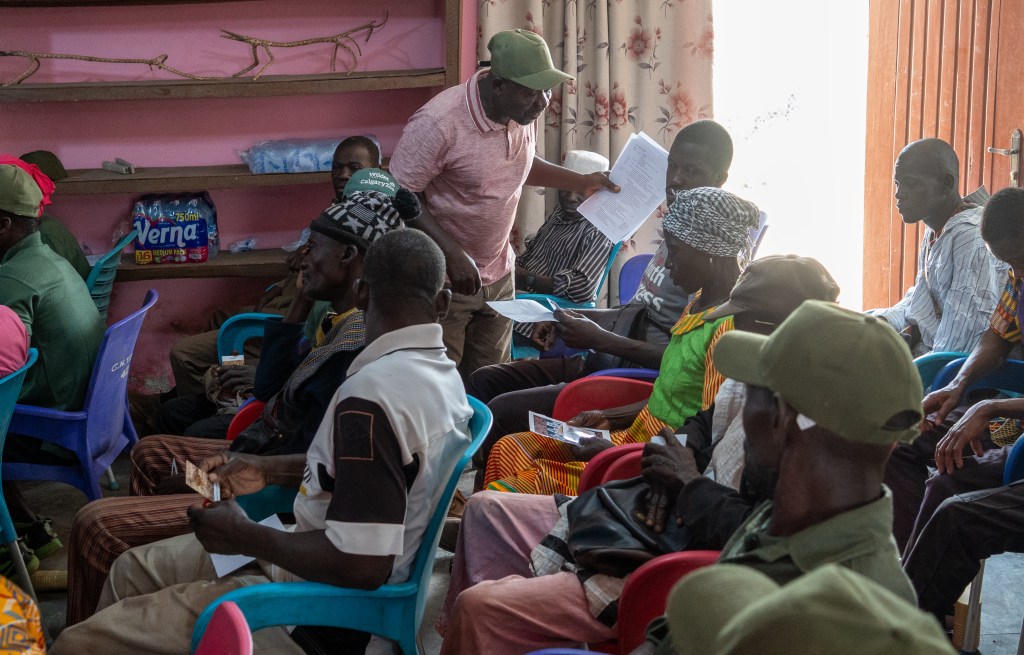
I’ve made a set of cards with images of birds on them and bring them with me when I’m out and about. People are excited to share their knowledge, and passionate about keeping it alive and transmitted to the generations to come, so I’m working with a couple of local people and an artist to develop a way to creatively record some of this information and ensure young people get to learn it. I’ll share more about this soon!

Thanks for reading, and if you are super keen and would like to get notified when I loose another set of words into the void you can sign up below.
 Claire Bracegirdle